

The Engineering That Goes Into a Custom Steel Door (That Nobody Sees)


Chad Crenshaw
When you look at a custom steel door, you see the finish, the glass, the hardware. And that’s fine — those are the things you touch every day.
But I see something different. I see a load path. I see wind pressure calculations. I see thermal expansion coefficients and weld joint stress distributions.
That’s the curse of being an engineer who builds doors for a living.
Here’s the thing most people don’t realize: a steel entry door — especially an oversized one that’s 8, 10, even 12 feet tall — is a structural element. It’s not a decoration. It’s not a home accessory like a faucet or a light fixture. It’s a moving wall that has to resist hurricane-force winds, handle hundreds of pounds of dead weight across a 20-year service life, and do it all while swinging on hinges with tolerances measured in thousandths of an inch.
And if you get the engineering wrong, you don’t get a second chance. You get a door that binds in summer, leaks in winter, sags on its hinges, or — worst case — fails structurally when you need it most.
So let me walk you through the engineering that goes into every Love That Door steel entry system. This is the stuff nobody sees. And that’s exactly the point.
Why 10-Gauge Cold-Rolled Steel Is the Foundation
Let me start with the material, because everything flows from this decision.
Most steel doors on the market are built from 16-gauge or even 18-gauge hot-rolled steel. That’s roughly 0.060 inches thick — about the thickness of a credit card. It’s stamped, formed, and shipped. It’s cheap, it’s fast, and it does the bare minimum.
We use 10-gauge cold-rolled steel. That’s 0.135 inches thick — more than double the material. But the gauge number only tells half the story. The cold-rolling process is what changes everything.
Cold rolling compresses the steel’s grain structure at room temperature, aligning the crystalline lattice in a way that increases yield strength by 15–20% compared to hot-rolled steel of the same thickness. Hot-rolled steel cools unevenly after forming, which creates internal stresses and inconsistent grain structure. Cold-rolled steel is dimensionally precise, surface-hardened, and — critically — consistent.
For a door, consistency means predictable structural behavior. When I calculate the load on a hinge stile or the deflection of a top rail under wind pressure, I need to know exactly how the steel will respond. With 10-gauge cold-rolled, I do. With 16-gauge hot-rolled, you’re guessing — and in engineering, guessing is how things fail.
That’s the foundation. Everything else we do builds on this material decision.
Load Calculations and Wind Ratings: What Your Door Actually Needs to Withstand
Texas doesn’t do mild weather. We get hurricane remnants from the Gulf, straight-line winds off the plains, and enough thermal cycling to destroy anything that wasn’t designed for it.
Every LTD door is engineered to handle wind loads that go well beyond what building codes require. I don’t design to the code minimum — I design to what actually happens. Wind load on a door isn’t uniform. The highest pressure zones are at the edges and corners of the slab, where the door meets the frame. These are the areas where cheap doors fail first — you’ll see the slab bow inward, the weatherstripping separate, and water intrusion begin.
My engineering team runs finite element analysis on every door configuration. We model the door as a structural system: the slab, the hinges, the frame, the anchoring into the rough opening. You can’t engineer a door in isolation — it has to work as part of the wall assembly.
For oversized openings — think 10-foot pivot doors or grand double-door entries — the engineering gets substantially more complex. A 10-foot-tall door slab weighs 400 to 600 pounds depending on glass configuration. That weight creates a moment arm at the hinges. Over time, even microscopic deformation compounds into visible sag. We engineer the hinge stile reinforcement, the continuous internal structure, and the frame anchoring to distribute that load so the door operates identically on day one and day 7,300.
This is the kind of engineering that happens when you have an in-house team that designs doors from scratch — not a sales office that orders from a catalog and hopes for the best.
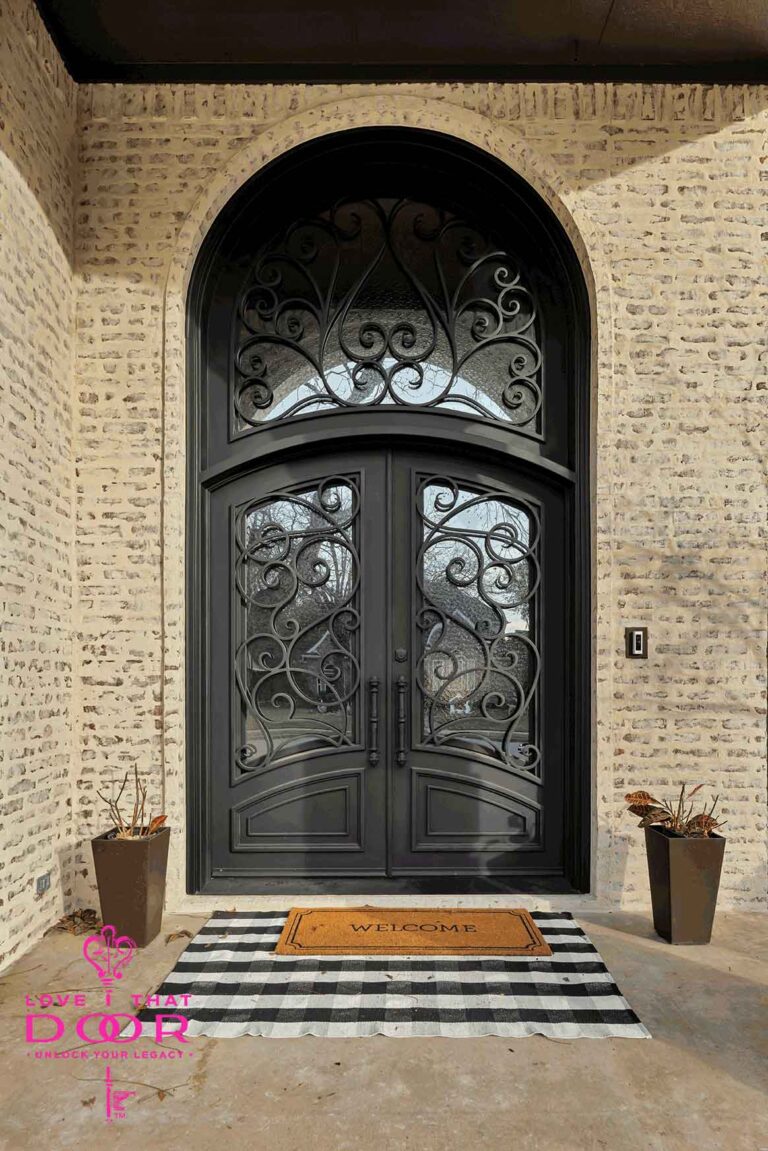
Thermal Expansion Engineering: Because Steel Moves
Here’s a number that surprises most people: steel expands at roughly 0.0000065 inches per inch per degree Fahrenheit.
That sounds tiny. But on a 96-inch-tall door slab, a 50-degree temperature swing — which is a normal Texas winter day, 35°F at dawn and 85°F by afternoon — produces 0.031 inches of thermal expansion. On an 8-foot door. In a single day.
Now imagine a dark-colored door facing west in August. The surface temperature can hit 140°F while the interior side stays at 72°F. That’s a 68-degree differential across the door thickness, creating differential expansion between the inner and outer skins.
If you don’t engineer for this, the door binds. The clearances that worked at 70°F disappear at 100°F. The lock bolt no longer aligns with the strike plate. The weatherstripping compresses unevenly and creates gaps.
Our solution is a thermally broken steel door construction. The thermal break in our steel doors is a polyurethane foam core injected between the inner and outer steel skins. This does three things simultaneously:
- It insulates — preventing heat transfer from the exterior skin to the interior
- It dampens the differential expansion by creating a thermal barrier between the two steel faces
- It adds structural rigidity by bonding the skins into a composite panel
This isn’t a gimmick. It’s physics, and it’s math, and it’s the difference between a door that performs for 20 years and one that starts failing after two Texas summers.
I’ve written about this in detail on our thermal expansion page, and it’s one of the most common failure modes I see in competitor doors — which I covered in our guide on how iron and steel doors fail.
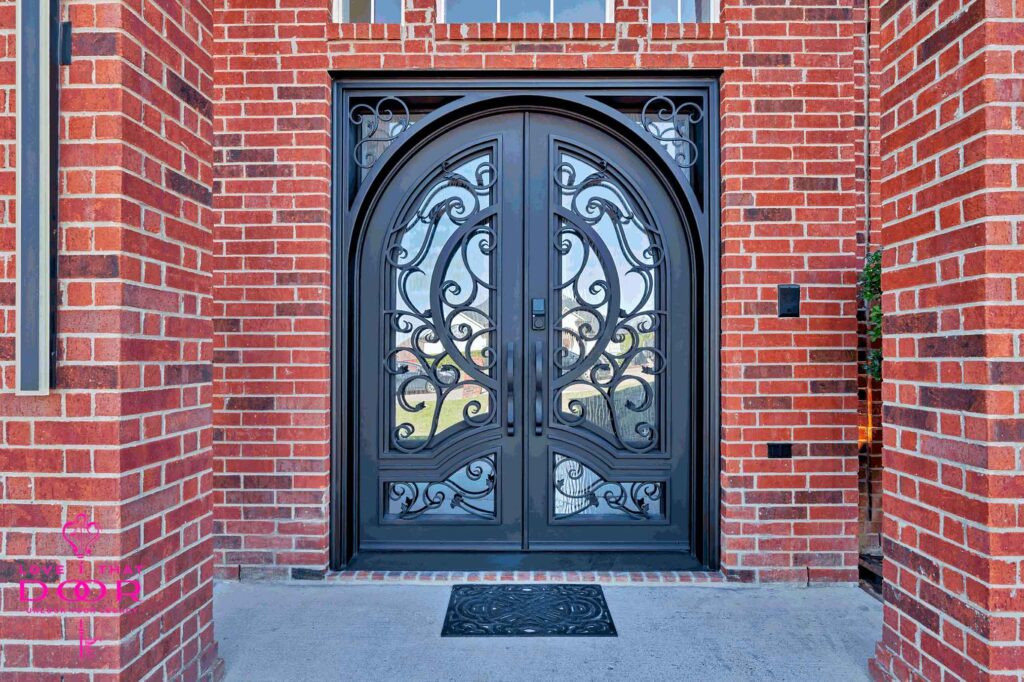
Transom Integration: One-Piece Engineering vs. Stacked Components
A transom over a door isn’t just a window — it’s a structural bridge. When you stack a transom on top of a door frame and bolt them together, you create a joint. Joints are failure points unless they’re engineered as an integrated system.
Our approach is what I call one-piece engineering. The door frame, transom frame, and all structural connections are designed as a single system in CAD before any steel is cut. The transom doesn’t sit on top of the door frame — it’s structurally continuous with it. This means the loads transfer through the system as if it were one piece, because as far as the engineering is concerned, it is.
When competitors do a transom, they typically order a standard door frame and a standard transom frame and screw them together on site. That joint carries wind load, dead load, and thermal stress — and it’s held together by field-installed fasteners.
I explain this in more depth on our door and transom engineering page, but the short version is: if your transom isn’t part of the original engineering model, it’s a liability.
Welds, Joints, and the Continuous Structural Tube
One of the most visible signs of engineering quality is what you see at the corners — or rather, what you don’t see.
When steel door frames are built as mitered pieces welded at the corners, you get visible weld beads, grinding marks, and eventually, stress cracks at the joint. I covered this in detail in my guide to visible welds vs. clean lines.
Our frames are constructed differently. Each frame member starts as a single piece of 10-gauge cold-rolled steel, formed into a continuous structural tube. The corners are precision-machined to interlock mechanically before welding, creating a joint that’s stronger than the base material. Then the entire frame is zinc-coated for corrosion resistance and finished with our triple-coat paint system.
This is manufacturing that you’d expect from automotive or aerospace — not from a door company. But that’s the standard we set because we own our factories and control the entire process from engineering through production.
What In-House Engineering Actually Means
I need to be direct about something. Most door companies don’t have engineers. They have salespeople who take orders from a catalog published by a factory they’ve never visited.
At Love That Door, the engineering happens here — in Texas. Our products are designed and engineered in Texas, and we own our factories overseas. That means when I need to change a hinge reinforcement design or run a new FEA model for a custom opening configuration, I walk down the hall and talk to the person who can make it happen. There’s no middleman, no catalog constraint, no “sorry, we can’t do that.”
This is why I patented our double-door construction. It’s why I own the factories instead of being another reseller. And it’s why our doors carry a lifetime warranty on the frame and slab — because when you control the engineering and the manufacturing, you can stand behind what you build.
The Engineering Nobody Sees
Here’s the bottom line: the engineering inside a custom steel door is invisible by design. If it’s done right, you never think about it. The door opens smoothly on a 105°F August afternoon. It seals tight in a January cold front. It doesn’t sag, bind, leak, or rattle. Year after year.
That’s not luck. That’s load calculations, material science, thermal expansion coefficients, and a thousand engineering decisions made before the first piece of steel was ever cut.
If you’re considering a custom steel door for your home — especially an oversized entry system — ask the hard questions. Ask about gauge thickness and cold-rolling. Ask about thermal breaks and wind ratings. Ask whether the engineering was done by an in-house team or by a catalog department in a different time zone.
Or better yet, just call us. I’d rather show you than explain it.
Schedule your free consultation — and bring your toughest engineering questions. I’ve got answers.
FAQs
A: 10-gauge cold-rolled steel (0.135 inches thick) provides more than double the material thickness of 16-gauge (0.060 inches). Beyond thickness, cold rolling increases yield strength by 15–20% over hot-rolled steel by compressing and aligning the grain structure. This means a 10-gauge cold-rolled door resists bending, sagging, and wind deflection far better than thinner alternatives — which is critical for oversized or heavy entry doors in Texas weather conditions.
A: In a steel door, the thermal break is a polyurethane foam core injected between the inner and outer steel skins. This foam layer creates an insulating barrier that prevents heat from conducting directly from the exterior steel face to the interior face. It also dampens the differential thermal expansion between the two skins — a critical factor in Texas where a dark door in direct sun can experience a 68°F temperature differential across its thickness. Without this thermal break, steel doors bind, warp, and leak as temperatures change.
A: Oversized door engineering starts with load path analysis — modeling how the door's weight (400–600+ pounds for a 10-foot slab) transfers through the hinge stile, into the hinges, through the frame, and into the rough opening structure. We reinforce the hinge stile with internal steel members, use continuous structural tube frame construction, and run finite element analysis to verify deflection stays within tolerance under both dead load and wind load. The anchoring system connecting the frame to the rough opening is engineered for the specific wall construction — not a one-size-fits-all approach.
A: Factory-direct engineering means the design team and the manufacturing facility are under the same ownership and communication loop. We can create custom engineering solutions — unique reinforcements, non-standard dimensions, integrated transom systems — because we control both the CAD models and the production line. Catalog ordering means a sales office selects from a fixed menu of options published by a third-party factory. Custom requests either get rejected or get an un-engineered workaround. We own our factories, so we don't have those limitations.
A: A properly engineered, factory-direct steel door built from 10-gauge cold-rolled steel with zinc corrosion protection, a polyurethane foam thermal break, and triple-coat paint should perform for 20–30+ years with minimal maintenance. That's why LTD offers a lifetime warranty on the frame and slab. The failure point on most steel doors isn't the steel — it's the engineering shortcuts that create stress concentrations, water intrusion paths, and thermal binding issues that compound over time. Good engineering eliminates those failure modes.
A: Yes — but only if it's engineered for it. A dark-colored west-facing steel door in Texas can reach 140°F surface temperature while the interior side stays at 72°F. That 68°F differential creates thermal expansion forces that warp un-engineered doors. Our solution combines a polyurethane foam thermal break between the skins (reducing heat transfer and differential expansion), engineered clearances that account for thermal movement, and 10-gauge cold-rolled steel whose dimensional stability resists the bending forces that thinner, hot-rolled steel cannot handle.