

Designing Indoor-Outdoor Living: Bifolds, Panoramics, and Lift-and-Slide


Chad Crenshaw
Indoor-outdoor living is one of the biggest design trends in Texas residential architecture. And it makes sense here — when you have a climate that’s genuinely outdoor-friendly for eight or nine months of the year, you want your home to take advantage of it.
But the door systems that make indoor-outdoor living work are genuinely complex engineering. The wrong system for your opening, your usage pattern, or your climate performance requirements will frustrate you every time you use it.
Here’s how I think about the three main system types — and how to choose.
What You’re Actually Solving For
Before we talk about product types, let’s talk about what you need the system to do.
Indoor-outdoor door systems have to solve several problems simultaneously:
- Opening size — How wide is the opening? How tall? Large openings require stiffer frame systems to avoid sag.
- Operation frequency — How often will the door be opened? Daily use, party entertaining, or occasional only?
- Weather seal requirement — Texas gets rain. Hard rain. How much water intrusion tolerance does your space allow?
- Thermal performance — All our systems are thermally broken, but the glass configuration also matters for your AC load.
- Aesthetic — Frame visibility, panel count, hardware finish, and sight lines vary significantly across system types.
Get clear on these before you pick a system type. The best bifold door in the world is wrong for an application that needs a lift-and-slide.
Bifold Doors: Maximum Opening, High Engagement
Bifold doors are the most visually dramatic indoor-outdoor system. Panels fold back accordion-style and stack against one or both jambs, leaving the opening almost entirely clear.
Best for:
- Covered patios and outdoor kitchens where you want full-wall opening regularly
- Spaces where you’ll open the door fully most of the time — not partially
- Shorter-to-medium openings (up to about 20–24 feet) where panel count stays manageable
- Applications where architectural drama is part of the design goal
What to know:
- More moving parts than sliders — hinges, pivots, and the folding mechanism all require quality hardware
- Panels swing into the interior or exterior as they fold (specify which way matters for your space)
- Full opening takes a little more physical engagement than sliding — you’re folding multiple panels, not just pushing one
- Our bifold systems are thermally broken and custom-sized; we don’t do stock sizes with filler strips
Bifolds look spectacular. In the right application, they’re the right answer.
Panoramic Systems: The Full Wall Solution
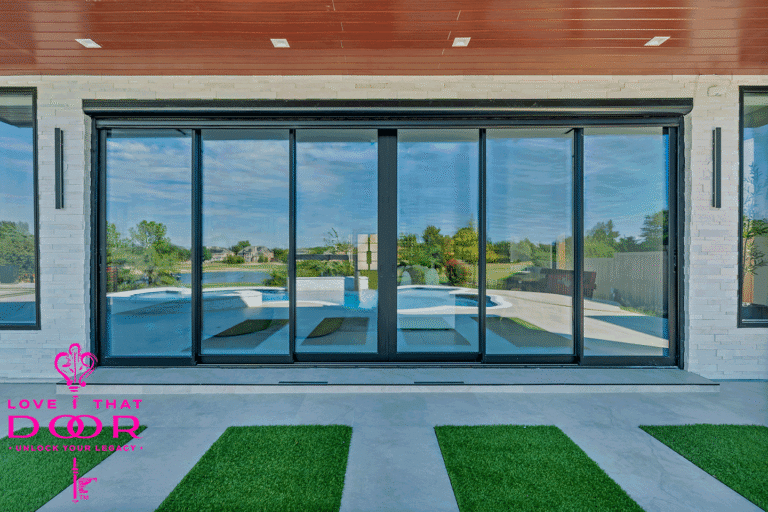
Panoramic door systems take the concept further — floor-to-ceiling glass walls that disappear when the system is open.
These are the systems you see in high-end resort architecture and luxury residential projects. When open, there’s essentially no visual or physical barrier between interior and exterior space. When closed, the view is maximized because the glass runs the full height of the opening.
Best for:
- Large openings (20+ feet) where you want the glass to dominate
- Applications where sight lines are a primary design goal
- Homes with views worth framing — pools, landscapes, Hill Country vistas
- Projects where the door is as much a design feature as a functional element
What to know:
- These systems require precise engineering — panel weight, frame rigidity, and hardware tolerance are all critical at scale
- The larger the system, the more important the frame quality becomes; thermal expansion across 20+ feet of aluminum is significant if the system isn’t designed for it
- Our drainage system matters even more here — a panoramic system is a lot of weather-exposed surface area
- Custom sizing is the only option at this scale; these are designed-to-opening systems
I’ll be honest: panoramic systems are where mediocre aluminum shows up fastest. The tolerances required for a 25-foot glass wall to operate smoothly for decades are tight. We own our factories specifically so we can control this level of precision.
Lift-and-Slide: High Performance in a Slim Profile
Lift-and-slide systems are the engineering choice for large openings when you want operational simplicity.
Here’s how they work: when you engage the handle to open, the panel lifts slightly off its sill seals, reducing friction dramatically. The panel then glides on the track. When you close and engage the handle, it lowers back onto the seals, compressing them for a tight weather closure.
Best for:
- Very large individual panels (each panel can be significantly wider than a bifold leaf)
- Applications where weather sealing is a top priority — lift-and-slide creates the tightest compressed seal of any operable system
- Openings where you want the visual simplicity of fewer, larger panels
- Clients who prefer minimal operation complexity — lift-and-slide is genuinely effortless once the mechanism is engaged
What to know:
- Panel count is lower than bifold, so each panel is wider and heavier; hardware quality is critical
- The lift mechanism requires proper installation and periodic adjustment — this isn’t a system for imprecise installation
- Weather seal performance is excellent, which makes lift-and-slide a strong choice in Texas for openings exposed to prevailing storm directions
- Thermal performance with our argon-filled, double-pane tempered glass is excellent at this scale
When someone comes to me with a 15-foot opening that faces the storm direction and they want minimal frame visibility, lift-and-slide is usually my recommendation.
Texas Climate: What Changes Your Calculus
The systems I’ve described exist in markets across the country. Texas adds specific factors that change how you should spec them.
Heat: All three systems need to be thermally broken to perform here. This isn’t optional in Texas — it’s the difference between a system that keeps your AC bill manageable and one that turns your indoor-outdoor space into a heat penalty.
Thermal expansion: Aluminum expands significantly in 100°+ heat. Over a 20-foot span, that movement is real. Frame design has to account for it in the track, hardware, and panel tolerances. We engineer our systems with Texas summer temperatures as a design condition, not an edge case.
Rain intensity: Texas storms are intense and sometimes fast. Our patented multi-stage drainage system exists because single-path drainage gets overwhelmed. For covered outdoor spaces, this is less critical. For exposed openings, it’s essential.
Wind: Large open panels in a Texas thunderstorm are a significant structural load. When we size hardware and frame for large systems, we engineer for realistic wind loads — not just code minimums.
Choosing the Right System for Your Project
Here’s my honest decision framework:
Choose bifold when: – You want dramatic full-opening capability regularly – Covered patio, outdoor kitchen, entertainment space – Opening up to about 20–24 feet
Choose panoramic when: – The view is the point — glass wall, maximum sight lines – Large openings where visual impact is a design priority – You want floor-to-ceiling glass height
Choose lift-and-slide when: – Weather sealing is a top priority – You want large individual panels with minimal frame – Operational simplicity matters
For most Texas projects, I also recommend pairing patio systems with our full aluminum collection — windows in the same thermally broken system, matching hardware finish, consistent aesthetic.
And if your project includes an iron entry door, our systems are designed to work together aesthetically. You don’t have to choose between iron entry drama and aluminum patio performance — you can have both.
Everything we build is custom-sized and factory-manufactured under our direct control. You get the system your opening requires, not whatever stock configuration is close enough.
→ Schedule your free consultation and we’ll work through which system fits your project, your opening dimensions, and your climate requirements.
If you’re evaluating door systems more broadly — including iron and steel entry options — the Iron & Steel Door Buyer’s Guide gives you the framework for asking the right questions of any manufacturer.
FAQs
A: Bifold doors fold accordion-style and stack against the jamb, leaving the opening almost fully clear. Lift-and-slide panels glide on a track after the handle lifts them off their seals — individual panels can be much wider, and the system provides superior weather sealing when closed. Best choice depends on your opening size, operation preference, and weather exposure.
A: Yes — if they’re thermally broken. Our systems use thermally broken aluminum framing and argon-filled double-pane tempered glass, which dramatically reduce heat transfer and keep your HVAC load manageable. Standard aluminum systems without thermal breaks are a poor choice in the Texas climate.
A: All our systems are custom-sized. We don’t use stock sizes with filler strips. Bifold systems work well to about 20–24 feet; panoramic and lift-and-slide systems can go larger. Contact us with your opening dimensions and we’ll specify the right system.
A: Yes — many of our clients do exactly this. We design both product lines with compatible aesthetic profiles so the combination looks intentional. Iron at the entry, thermally broken aluminum at the patio openings is one of the most popular combinations we build.