

Why Thermal Breaks Aren’t Optional in Texas


Chad Crenshaw
If you’ve shopped for a high-end door in the last five years, you’ve heard the term “thermal break.” It shows up in every brochure, every website, every sales pitch. And almost nobody explains what it actually means — or why it matters differently depending on whether you’re buying a steel entry door or an aluminum patio door system.
I’m going to fix that. Because a thermal break isn’t one thing. It’s two completely different things depending on what your door is made of. And in Texas, where your front door can hit 140 degrees on an August afternoon, getting this wrong costs you money every single month.
The Universal Problem: Heat Moves Through Metal
Let’s start with what a thermal break solves. Metal — steel or aluminum — is an excellent conductor of heat. On a 100-degree Texas day, the exterior surface of your door can reach 140 degrees or more. Without something to interrupt that heat flow, the interior surface of your door will get hot too. Your air conditioner fights that heat gain. Your energy bill reflects that fight.
A thermal break is exactly what it sounds like: something that breaks the thermal pathway from outside to inside. It interrupts the conduction of heat through the door material. But how you create that break depends entirely on whether you’re working with steel or aluminum — and this is where most explanations fall apart.
Thermal Breaks in Steel Entry Doors: The Core That Does the Work
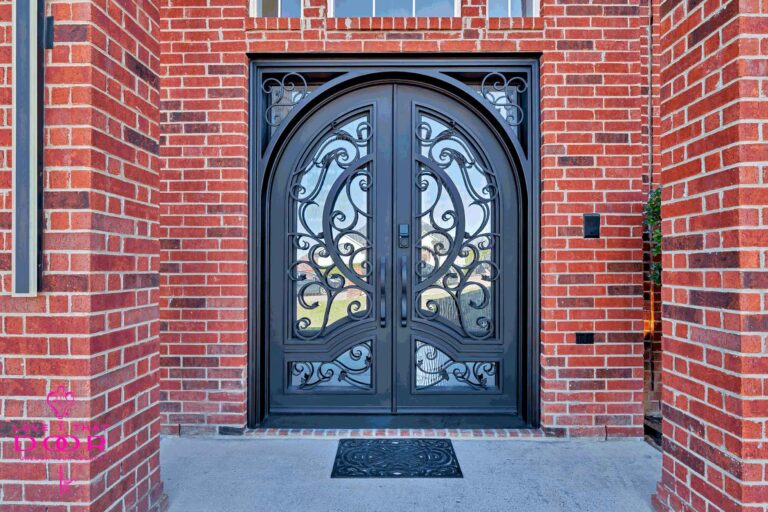
A steel entry door — and I mean a real one, made from 10-gauge cold-rolled steel like what we build at Love That Door — is essentially two steel skins with a space between them. Without something in that space, you’d have a hollow metal box that conducts heat straight through.
The thermal break in a steel door is a polyurethane foam core injected between the inner and outer steel skins. This foam serves two functions. First, it insulates — polyurethane foam has an R-value of roughly 6.5 per inch, dramatically higher than fiberglass batts or polystyrene. Second, and this is what makes it a true thermal break, it separates the two steel skins so they don’t touch each other. The steel on the outside gets hot, but that heat has to travel through several inches of foam before it reaches the steel on the inside. By the time it gets there, it’s negligible.
You can feel the difference instantly. Put your hand on a hollow steel door on a hot day — the inside surface is warm, sometimes hot. Put your hand on a foam-core steel door built the same way, and the inside surface is room temperature. That’s the thermal break doing its job.
At Love That Door, our steel entry doors use full-density polyurethane foam cores — no voids, no shortcuts. The foam is injected under pressure and expands to fill every cavity in the door slab. That’s the difference between a thermal break that works for five years and one that works for thirty.
Thermal Breaks in Aluminum Patio Doors: The Geometry That Slows Heat
Aluminum is different — and this is where even industry professionals get confused. You can’t put a foam core in an aluminum extrusion the way you can in a steel door slab. Aluminum patio doors, bifolds, and lift-and-slide systems are built from extruded aluminum profiles — long, precisely shaped pieces of aluminum that form the frame, the rails, and the stiles of each door panel.
The thermal break in aluminum isn’t a separate material inserted into the frame. It’s engineered into the geometry of the aluminum extrusion itself. The extrusion profile includes deliberate bends, chambers, and air gaps that slow heat transfer by forcing it to travel a longer path through a material that conducts less efficiently when shaped this way.
Think of it like a maze. Heat tries to travel from the outside face of the aluminum frame to the inside face. A solid aluminum bar would let it travel straight through in a fraction of a second. A thermally broken aluminum profile forces that heat to navigate a zigzag path through thin walls and across air gaps. Each bend adds resistance. Each air gap stops conduction entirely — air is a terrible conductor of heat, which is exactly what you want.
This is not a polymer insert. It’s not a plastic strip snapped into the frame. The thermal break IS the shape of the aluminum. The bends, the chambers, the air spaces — that’s the break. Our thermally broken aluminum systems use proprietary extrusion profiles engineered specifically for this purpose.
Why Texas Makes Both Types Non-Negotiable
Texas isn’t Arizona. We don’t just have heat — we have heat PLUS humidity. That combination is brutal on doors.
When a steel door without a proper thermal break heats up on the outside while the inside stays air-conditioned, condensation forms. Not on the outside, where you’d wipe it away — inside the door slab, between the skins, where you can’t see it. That hidden moisture corrodes the steel from the inside out. Over years, it weakens the door, degrades the paint adhesion, and eventually causes visible rust bleeding through the finish. That’s not a paint failure — it’s a thermal break failure.
When an aluminum patio door without a proper thermal break heats up, the aluminum expands. Aluminum’s coefficient of thermal expansion is roughly twice that of steel. A 20-foot bifold opening in full Texas sun can expand by a quarter-inch or more over the course of a day. If the frame doesn’t have the engineered flex spaces that a thermal break design provides, that expansion stress goes into the glass — and tempered glass under edge stress is a failure waiting to happen.
I’ve seen aluminum bifold doors in Dallas homes that would stick at 3 PM every afternoon and glide smoothly at 8 AM. That’s not a hardware problem. That’s thermal expansion without a proper break. Our aluminum patio door systems are engineered from the extrusion up to handle Texas temperature swings without binding, without seal failure, and without replacing glass every few years.
How to Verify a Thermal Break (Before You Buy)
You can’t see a thermal break. That’s the problem. Unscrupulous manufacturers can claim their doors are “thermally broken” because it’s a feature you can’t verify by looking at the product. Here’s how to verify it:
For steel doors: Ask what the core material is and how it’s installed. If the answer is “polystyrene sheet” or “fiberglass batt,” walk away. Those are insulation — they’re not a thermal break, because neither material prevents the two steel skins from making contact at the edges. A true thermal break requires injected polyurethane foam that fills the entire cavity and separates the skins completely. Ask to see the injection ports on the door edge — every properly constructed foam-core door has visible port holes where the foam was injected.
For aluminum doors: Ask to see a cutaway sample of the extrusion profile. A reputable manufacturer will have one. Look at the cross-section — you should see a complex shape with multiple chambers, thin connecting walls, and deliberate air gaps between the interior and exterior faces. If the cross-section looks like a simple rectangle or a basic C-channel, there’s no thermal break engineered into the profile. It’s solid aluminum that will conduct heat straight through.
Also check the thermal performance ratings. A properly thermally broken aluminum door system should achieve a U-factor of 0.30 or lower. If the manufacturer can’t provide U-factor test results, assume the thermal break exists only in the marketing copy.
The Bottom Line: Pay Now or Pay Forever
A door without a proper thermal break costs you every month in higher energy bills. Over 10 years, the extra cooling cost from a non-thermally-broken door in Texas can easily exceed what you saved by buying the cheaper door in the first place.
At Love That Door, every steel entry door we build has a full-density polyurethane foam core. Every aluminum patio door system we install uses thermally broken extrusion profiles engineered for Texas conditions. We don’t offer a “budget” option without thermal breaks, because a door that can’t handle Texas weather isn’t a door — it’s a future service call.
Come see the difference at any of our four DFW showrooms. Put your hand on the inside of one of our doors on a 100-degree day. Feel the thermal break working. That’s engineering you can touch.
without a proper break. Our aluminum patio door systems are engineered from the extrusion up to handle Texas temperature swings without binding, without seal failure, and without replacing glass every few years.
How to Verify a Thermal Break (Before You Buy)
FAQs
A: Insulation slows heat transfer — it's a resistance layer. A thermal break physically separates the hot and cold sides of a door so they don't touch each other. In a steel door, the polyurethane foam core does both: it insulates AND it separates the steel skins. In aluminum, the thermal break is the geometry of the extrusion — the bends and air gaps that force heat to travel a much longer path.
A: In steel doors, yes — if the foam core was poorly injected, leaving voids, those voids become condensation traps. The foam itself doesn't degrade, but air gaps defeat the purpose. In aluminum, the thermal break IS the extrusion shape, so it can't "fail" in the conventional sense — but poor-quality extrusions with minimal bends and chambers don't provide meaningful thermal breaks to begin with.
A: Fiberglass is naturally a poor conductor of heat — its thermal conductivity is roughly 1/500th that of aluminum. Fiberglass doors typically use a foam core for insulation, but they don't need the same engineered thermal break because the material itself doesn't conduct heat efficiently. The trade-off is that fiberglass doesn't match the strength, security, or architectural presence of steel.
A: In Texas, a properly thermally broken door versus a non-broken equivalent can reduce heat gain through the door by 40-60%. For a typical DFW home with a large patio door opening, that translates to $15-40 per month in reduced cooling costs during summer months — or roughly $100-300 annually depending on door size and sun exposure.
A: The cost difference between a thermally broken and non-broken aluminum door system is typically 15-25% of the door package price. Over the 20-30 year lifespan of a quality aluminum door system, the energy savings alone recover that premium several times over — not counting the avoided costs of condensation damage, glass seal failure, and the comfort difference you'll feel every single day.