

Why Thermally Broken Aluminum Changed Everything for Patio Doors


Chad Crenshaw
People think of me as an iron door guy. And that’s fair — our iron and steel entry doors are what most people know us for.
But my engineering background isn’t iron-specific. It’s about solving thermal, structural, and performance problems in high-end doors. And the same problems I saw in cheap iron doors? I see them in aluminum patio systems every day.
Standard aluminum patio doors are terrible in Texas. Here’s why — and why thermally broken aluminum is the only answer.
The Problem With Standard Aluminum
Aluminum is a great building material. It’s strong, lightweight, and doesn’t rust.
But it has one significant engineering flaw for use in Texas homes: aluminum conducts heat extremely well.
Put a standard aluminum door in a Texas summer and you’ve installed a giant heat bridge between your outdoor temperature and your air-conditioned interior. The frame conducts thermal energy through the wall — no insulation, no break, just a direct path.
What does that cost you?
- Higher cooling bills as your HVAC fights the heat transfer
- Condensation on the interior frame surface when cold indoor air meets the hot metal
- Warping or seal failure as the frame expands dramatically in 100°+ heat
- Interior discomfort near large door openings, even with the door closed
For a single door, these effects are annoying. For a large sliding system, bifold, or panoramic wall — which can span 10, 15, or 20 feet — they’re significant.
What "Thermally Broken" Actually Means
This term gets used in marketing a lot. Let me give you the engineering version.
A thermally broken aluminum frame has a deliberate interruption — a “break” — in the aluminum profile. That break is created by bends engineered into the aluminum extrusion itself, forming separated chambers that eliminate the direct thermal path through the metal.
The result is two separate aluminum chambers: one facing the exterior, one facing the interior. The bends in the profile provide structural continuity without thermal continuity.
Heat can no longer conduct straight through the frame. The air gaps created by those bends act as insulation at the most critical point — the frame itself.
In practical terms:
- The interior frame surface stays close to room temperature even on a 105° Texas day
- No condensation on the frame
- Dramatically reduced thermal load on your HVAC
- The frame expands and contracts more evenly, protecting seals and hardware over time
This is not a minor upgrade. For large patio openings in Texas, thermal break framing is the difference between a system that performs and one that fights you every summer.
Argon-Filled, Double-Pane Tempered Glass — Why It Matters
The frame is only part of the thermal equation. The glass is the other half.
Our entire aluminum collection — sliding doors, bifold systems, panoramic walls, and windows — uses argon-filled, double-pane tempered glass as standard.
Here’s why each element matters:
- Double-pane: Two panes of glass with an insulating gap between them. The trapped air (or gas) resists heat transfer far better than a single pane.
- Argon-filled: Argon gas is denser than air, which means it conducts heat even less efficiently. Swapping air for argon in that gap meaningfully improves thermal performance without adding any thickness.
- Tempered: Safety glass that, if broken, shatters into small rounded pieces rather than sharp shards. Required by code for large door applications and critical for families with children.
When you combine thermally broken framing with argon-filled double-pane tempered glass, you get a patio system that’s genuinely energy-efficient — not just code-compliant.
Our Aluminum Line: Sliding, Bifold, Panoramic, and Windows
I designed our aluminum systems to cover the full range of indoor-outdoor living applications.
- Sliding doors — Our multi-panel sliders can span large openings while maintaining smooth operation. The thermal break framing means the hardware doesn’t bind from heat-related expansion.
- Bifold doors — Panels fold back accordion-style to open an entire wall. These are popular for covered patios and outdoor kitchens where you want full airflow control.
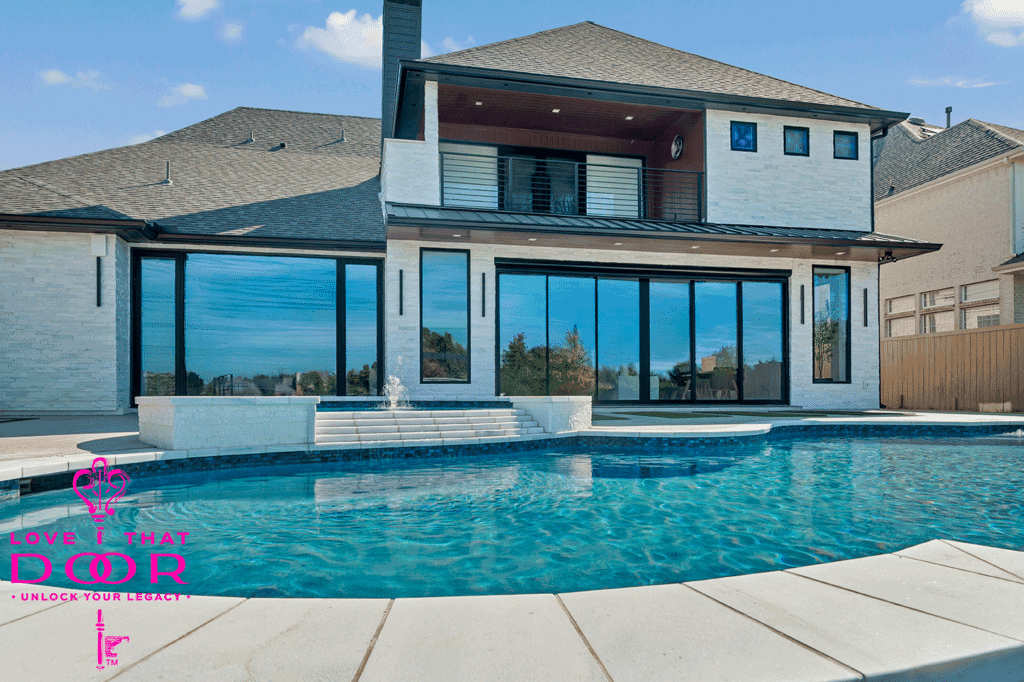
- Panoramic systems — The most dramatic option. Floor-to-ceiling glass walls that disappear when open. These require the most precise engineering — frame rigidity, seal integrity, and hardware tolerance all have to be exactly right at scale.
- Windows — The same thermally broken, argon-filled, double-pane system extends to our window line. If you’re doing a full design, matching your windows to your door system matters for both performance and aesthetics.
Everything we build is custom-sized. We don’t sell stock sizes with filler strips. Your opening, your configuration — manufactured to fit.
The Patented Drainage System
Texas doesn’t just get hot. It gets rain — sometimes a lot of it, fast.
One of the engineering details I’m proudest of in our aluminum systems is the drainage design. We’ve patented our drainage channel configuration to handle high-volume water intrusion without allowing it to reach the interior.
Most patio door systems rely on a single drainage path. Under heavy rain with any wind pressure, water can overcome that path and intrude.
Our system uses a multi-stage approach:
- Primary drainage channels at the threshold and sill
- Secondary drainage capture that intercepts any overflow
- Positive drainage slope maintained across the system, not just at the edges
In Texas, where a storm can dump an inch of rain in 20 minutes, this matters. I’ve seen luxury homes with premium patio doors get interior water damage from a single severe storm. That doesn’t happen with our drainage design.
Why I Expanded Into Aluminum
I want to answer the obvious question: why does an iron door company build aluminum patio systems?
Because the problems are the same. Homeowners investing in high-end architecture deserve products that are engineered correctly — not just products that look good in a showroom and underperform in the field.
When I looked at the aluminum patio door market, I saw the same gaps I’d seen in iron doors: commodity thinking, cheap shortcuts on thermal performance, and manufacturing processes that nobody owned or controlled.
We own our factories. We control every specification, every material grade, every quality checkpoint. That’s how we build iron doors, and it’s how we build aluminum systems.
If you want to understand how we evaluate any door — iron or aluminum — start with the Iron & Steel Door Buyer’s Guide for the underlying framework, then look at our full aluminum collection for the specific systems.
Ready to talk through what system fits your project? Schedule **your** free consultation — and I’ll walk you through the options.
FAQs
A: It's an aluminum door frame with a deliberate break in the metal profile, created by bends engineered into the aluminum extrusion. These bends form separated chambers that prevent heat from conducting straight through the frame — which is a major problem with standard aluminum doors in hot climates like Texas.
A: Yes — especially for larger openings. The HVAC savings, elimination of condensation, and longer hardware life offset the cost difference. For bifold, panoramic, or large sliding systems, standard aluminum is simply the wrong product for the Texas climate.
A: All our aluminum doors and windows include argon-filled, double-pane tempered glass as standard. Argon fill improves thermal insulation over air-filled units; double-pane provides the insulating gap; tempered glass meets safety code requirements for large door applications.
A: Yes. We design both systems with compatible aesthetic profiles so a home with iron entry doors and aluminum patio systems looks intentional, not mismatched. Many of our clients do exactly this.