

5 Mistakes Homeowners Make Choosing Patio Doors (And What to Do Instead)

Home » 5 Mistakes Homeowners Make Choosing Patio Doors (And What to Do Instead)

A patio door is one of the most expensive components in a home renovation — and one of the easiest to get wrong. The mistakes aren’t obvious at purchase.
They show up 2-3 years later when the door sticks, the seals fail, the energy bill spikes, or the track fills with water during a storm.
Here are the five most common mistakes we see, why they happen, and what to do instead.
Mistake #1: Choosing
Based on Appearance Alone
Love That Door®

Two patio doors can look identical in a showroom. Same aluminum frame. Same glass. Same modern aesthetic. One costs $8,000. The other costs $18,000.
The difference is everything you can’t see: the thermal break design, the hardware system, the glass package, the sealing technology, the weight rating, and the engineering behind the operation.
The $8,000 door might use a single plastic strip as a “thermal break,” standard air-filled glass, commodity rollers, and foam seals. The $18,000 door might use multiple polyamide thermal breaks, argon-filled LOW-E glass, German-engineered hardware rated for 970 lbs, and EPDM perimeter gaskets.
Both look the same on Day 1. By Year 3, only one still operates like it did when it was installed.
What to do instead: Compare specifications, not appearances. Ask for U-values, weight ratings, hardware certifications, and glass specs. If a company can’t provide these, you’re buying a finish, not a door system.
Book your FREE in-home or showroom consultation today—we'll measure your space, explore custom designs, and bring your vision to life!
Get a FREE quote! Share your measurements or a photo of your space, and our design experts will send you a personalized price estimate.
Mistake #2: Ignoring
the Threshold
Love That Door®

The threshold is the bottom of the door frame — the part your foot steps over, the part that sits on the sill plate, the part that bridges interior and exterior.
Most homeowners never think about it. Most door companies don’t want you to.
The threshold is the single largest thermal bridge in any patio door system. It’s also where water infiltration is most likely, where structural settling affects operation first, and where debris accumulates to jam rollers.
A premium threshold has:
- Thermal break technology (separate from the frame’s thermal break)
- Integrated drainage channels
- Low-profile design (flush or near-flush with the floor)
- Materials engineered to resist thermal expansion
Love That Door® uses a German-engineered threshold system with a U-value of 0.77 W/m²K — engineered with a material mix that prevents distortion from temperature changes. No cold bridges, no water pooling, no expansion problems.
What to do instead: Ask specifically about the threshold. What’s the U-value? Is it thermally broken independently from the frame? How does it handle drainage? If the salesperson can’t answer, the threshold is probably an afterthought.
Mistake #3:
Underestimating Hardware
Love That Door®
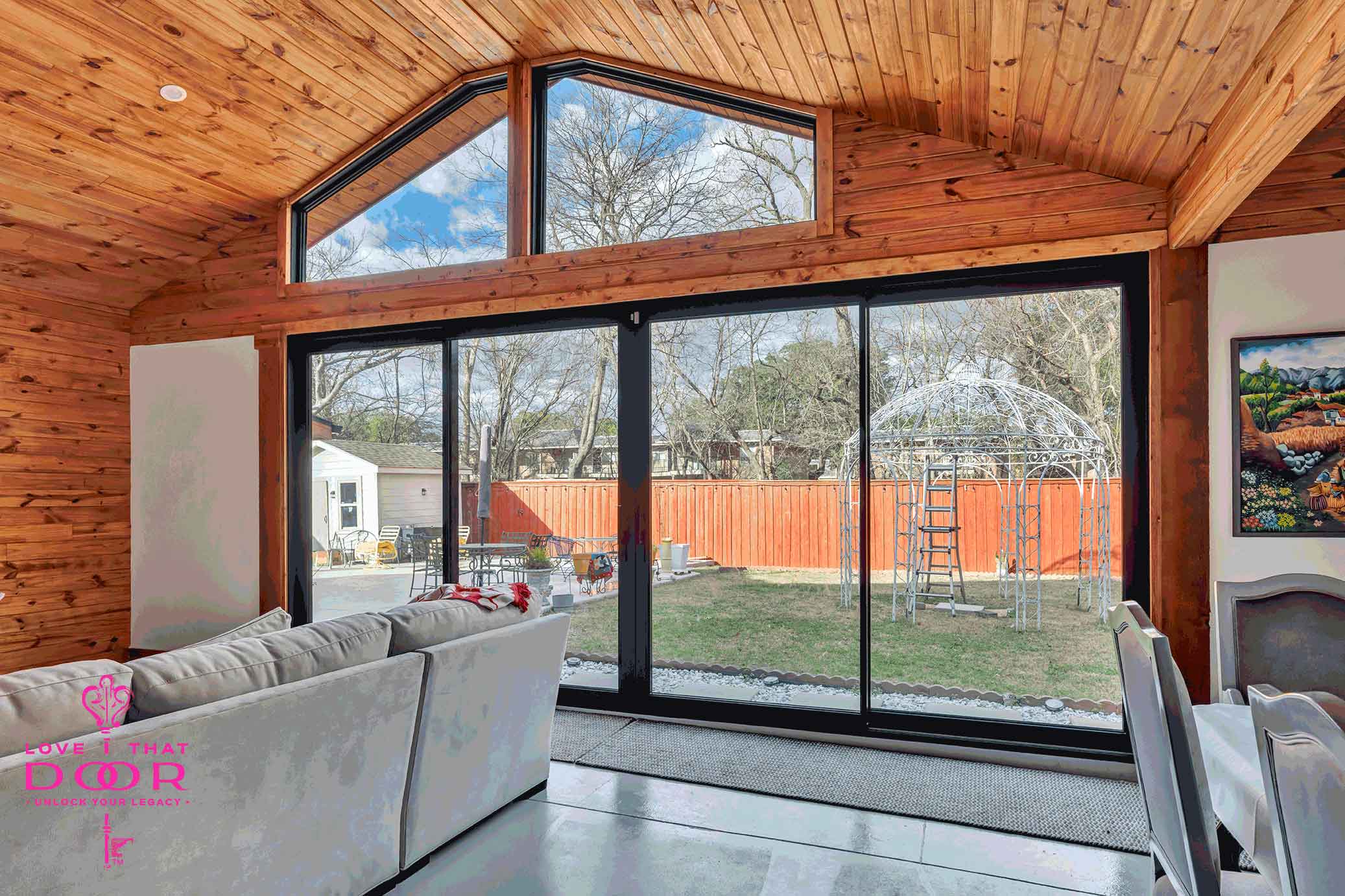
The hardware is the engine of the door. Rollers, tracks, hinges, locks, and lifting mechanisms determine how the door operates every single day for its entire life.
Cheap hardware reveals itself slowly:
- Rollers wear and panels start dragging
- Tracks collect debris with no self-cleaning mechanism
- Locks engage at one point instead of multiple points
- Lifting mechanisms lose calibration and require increasing force
- Hinges develop play and panels wobble
By the time you notice, the damage is done — and replacing hardware often means replacing the door.
Love That Door® sources German-engineered hardware systems with:
- Self-cleaning tracks (built-in brushes on the bogies)
- Multi-point locking (security and seal compression)
- Rolling hinges for bifolds (bearing-based, not static)
- Effortless lift-and-slide operation (no stacking, no folding, no failure points)
- Anti-lift security bolts (DIN EN 1627 RC 2-3 certified)
What to do instead: Ask where the hardware is made, what weight it’s rated for, and whether the tracks have self-cleaning features. Operate the door in the showroom — not once, but five or six times. Smooth on the first try doesn’t prove anything. Smooth on the hundredth does.
Book your FREE in-home or showroom consultation today—we'll measure your space, explore custom designs, and bring your vision to life!
Get a FREE quote! Share your measurements or a photo of your space, and our design experts will send you a personalized price estimate.
Mistake #4: Skipping the Thermal
Break (Or Accepting a Fake One)
Love That Door®
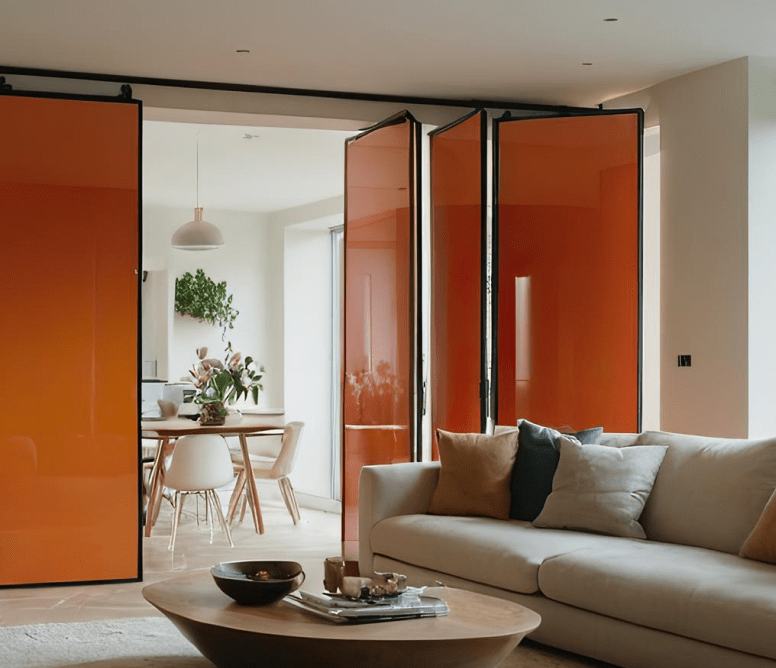
“Thermally broken” appears on nearly every aluminum door listing. But there’s a range of quality between a token plastic strip and a real multi-point thermal break system.
In a Texas climate, inadequate thermal breaks cause:
- Hot frames that transfer heat into your room
- Condensation on interior glass and frame surfaces
- Higher HVAC costs during 5+ months of summer
- Thermal expansion that affects door operation over time
A real thermally broken system has multiple insulating barriers throughout the frame AND the threshold, uses reinforced polyamide (not plastic), and can provide tested U-values for the complete assembly.
What to do instead: Ask to see a cross-section of the frame. The thermal break should be visible — a distinct barrier between the exterior and interior aluminum. Ask for the U-value of the complete door assembly including the threshold. If they only quote the glass, they’re hiding the frame performance.
Mistake #5: Hiring
the Wrong Installer

You can buy the best-engineered patio door in the world and ruin it with poor installation. Patio doors require:
- Precise level and plumb (even small deviations affect operation)
- Proper shimming and structural support
- Correct sealing at the frame-to-structure junction
- Track alignment and roller calibration
- Threshold drainage verification
- Multi-point lock adjustment
General contractors can handle standard doors. Premium patio door systems — especially large-format, multi-panel, or automated configurations — need installers who understand the specific engineering of the product they’re installing.
Love That Door® doesn’t use subcontractors for installation. Our team installs every door, calibrates every mechanism, and verifies every seal. The same company that engineered and built the door is the one standing in your opening making sure it works perfectly.
And we don’t use silicone to seal the exterior. We use Polyblend ceramic sanded caulk — a premium siliconized acrylic that matches your mortar, flexes with structural movement, and resists cracking in Texas heat. It’s the kind of detail that separates a professional installation from a standard one.
What to do instead: Ask who installs the door. If the answer is “our subcontractor” or “your general contractor,” ask what happens when something goes wrong. Then ask Love That Door® the same question.
The Real Test
Love That Door®

Visit a showroom. Operate the doors. Ask the questions listed above. Compare the answers.
The mistakes on this list all have one thing in common: they’re invisible at the point of purchase and obvious after installation. The only way to avoid them is to compare engineering, not marketing.
Love That Door® has patio doors on display at all four DFW locations:
- Dallas — 1322 Round Table Dr
- Frisco — 2429 Preston Rd, Ste. 400
- Fort Worth — 9100 N Fwy, Suite 100
- Grapevine — 129 S Main St, Ste 150
Expert Insight

From Chad Crenshaw, Founder & Chief Engineer:
“I’ve seen homeowners spend $15,000 on a patio door and get it installed by a handyman with a tube of silicone. That door will fail — not because of the product, but because nobody who understood it was there when it went in. We build the door and we install the door. Same team, same standard.”
Book your FREE in-home or showroom consultation today—we'll measure your space, explore custom designs, and bring your vision to life!
Get a FREE quote! Share your measurements or a photo of your space, and our design experts will send you a personalized price estimate.
Frequently Asked
Questions
01.
Q: What is the biggest mistake when buying patio doors?
A: The biggest mistake is choosing based on appearance alone. Two doors can look identical but use completely different hardware, glass packages, and frame construction. One lasts a lifetime, the other starts failing in 3-5 years. Always compare specifications — U-values, weight ratings, hardware certifications — not just how the door looks in the showroom.
02.
Q: Do I need thermally broken patio doors in Texas?
A: Yes. Without a thermal break, an aluminum patio door frame conducts heat directly into your home — aluminum is about 800 times more conductive than wood. In Texas summers where surface temperatures exceed 150°F, a non-thermally-broken frame acts as a radiator. This increases HVAC load, creates hot spots near the door, and can cause condensation damage.
03.
Q: How long should a quality patio door last?
A: A premium aluminum patio door with German-engineered hardware, thermally broken frames, and proper installation should last decades with minimal maintenance. Love That Door® offers a lifetime warranty on frames and slabs and a 10-year finish warranty. Cheap patio doors typically begin showing operational problems within 3-7 years.
Book your FREE in-home or showroom consultation today—we'll measure your space, explore custom designs, and bring your vision to life!
Get a FREE quote! Share your measurements or a photo of your space, and our design experts will send you a personalized price estimate.
Get a free quote
REQUEST A QUOTE
Ready to Elevate Your Home with Custom Doors and Windows?
Fill out your contact details and let our design experts guide you through the process:
- Free in-home consultation tailored to your needs.
- Rough measurements and custom design for a perfect fit.