

Aluminum Patio Doors: Texas Storm Season — Chad Crenshaw


Chad Crenshaw
Aluminum patio doors handle Texas storm season through three layers of engineering: wind pressure ratings tested to meet coastal-tier requirements, impact-resistant laminated glass that keeps the building envelope sealed after debris strikes, and a thermal break system that prevents condensation during violent temperature swings.
What Wind Ratings Do Aluminum Patio Doors Need in Texas?
Wind rating isn’t one number — it’s a set of tests that measure how much pressure a door can take before it fails structurally, before glass deflects too far, and before air or water pushes through the seals.
- Design Pressure (DP) rating tells you how much positive and negative pressure the door handles without permanent deformation — negative pressure is the suction on the leeward side that can pull a door outward harder than wind pushes against it
- Our aluminum bifold and lift-and-slide systems are spec’d to DP50 or higher as standard, with higher ratings available for exposed locations like hilltops or open prairie
- Our aluminum patio doors are tested to meet Texas wind zone requirements up to the coastal tier, with pressure testing that simulates sustained winds over 130 mph — equivalent to a strong Category 3 hurricane
- The testing standards we use — ASTM E330 for structural load, ASTM E1886/E1996 for impact, ASTM E283 for air infiltration, ASTM E547 for water penetration — are the difference between a brochure door and one that keeps your house dry when the storm hits
Schedule your free consultation at any of our 4 DFW showrooms.
Can You Get Impact-Resistant Glass on Aluminum Patio Doors?
Yes — and in some parts of Texas, you should. Impact-resistant glass uses a laminated construction that keeps the panel intact even after windborne debris hits at 50+ feet per second.
- Laminated impact glass bonds two sheets of glass with a PVB interlayer — when debris strikes at ASTM E1996 test speeds, the glass cracks but stays in the frame, keeping the building envelope sealed
- We recommend impact-resistant glass for homes within 50 miles of the Gulf Coast, properties with large glass walls facing the prevailing wind direction, and any opening where a breached panel would pressurize the house and risk the roof
- Impact-resistant glass adds roughly 15-20% to your glass package cost compared to standard tempered — the tradeoff is skipping storm shutters or plywood panels entirely, with protection always built in
- Standard tempered glass handles wind pressure fine until a tree branch hits it at 60 mph — then you have an open hole, the house pressurizes, and that’s the failure sequence that peels roofs off — impact glass interrupts that chain at step one
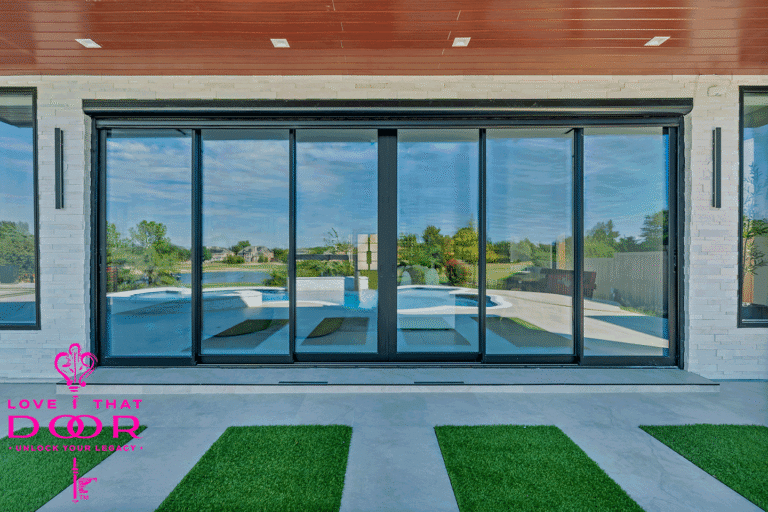
How Does Weather Sealing Work on Aluminum Patio Doors?
Weather sealing on a patio door is a system, not a single gasket. I think about it in three layers.
- First layer — exterior EPDM gaskets: Compression seals that run the full perimeter of each panel, compressing when the panel closes to create the primary weather barrier; EPDM rubber won’t harden or crack under UV the way PVC seals do after a few Texas summers
- Second layer — interlock seals: Where two panels meet, our interlock profiles are extruded with the gasket channel built in — not glued on — so wind-driven rain can’t find the gap and push through
- Third layer — sill drainage: Water that makes it past panel seals hits the sill and routes out through weep holes via an internal slope — water can’t pool, it drains by gravity to the exterior
- Our exterior sealing on all aluminum installations uses Polyblend ceramic sanded caulk — never silicone, which separates from aluminum over thermal cycles; ceramic caulk bonds permanently through 30°F to 105°F swings in a single week
Schedule your free consultation at any of our 4 DFW showrooms.
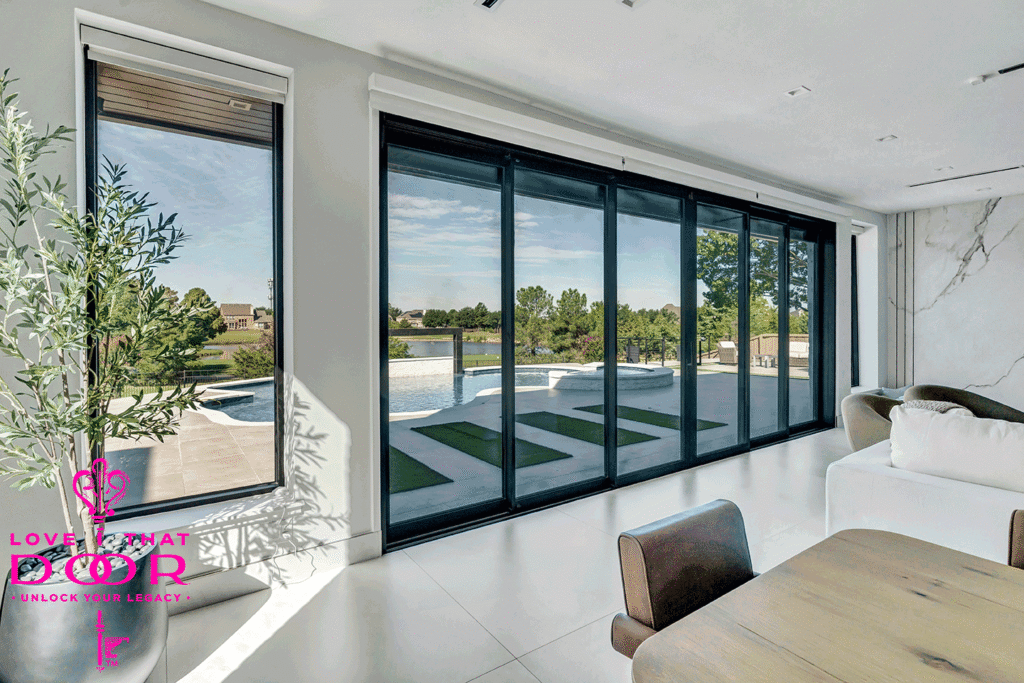
Why Do Thermal Breaks Prevent Condensation During Temperature Swings?
Condensation forms when warm, humid indoor air hits a cold surface. Without a thermal break, the aluminum frame conducts outside cold straight through to the interior face — and humidity condenses right on your frame.
- A thermal break in aluminum uses engineered bends in the extrusion profile that create air gaps, interrupting the conductive path so cold can’t travel straight through solid metal from the outside face to the inside face
- The interior face of a thermally broken frame stays close to room temperature — when it’s 35°F outside and 72°F inside, the frame surface might be 65°F instead of 40°F, which is the margin between dry glass and condensation dripping onto your floor
- This matters double in Texas because temperature swings are violent — a cold front can drop 40 degrees in six hours, and the thermal break keeps your energy efficient patio door from sweating through the transition
- The thermally broken frame works with your glass package, not instead of it — the thermal break stops heat conduction through metal, the Low-E coating stops radiant heat through glass; you need both
FAQ
Q: Can aluminum patio doors survive a Texas hurricane?
A: Yes — when they’re engineered for it. Our aluminum patio doors meet wind pressure ratings that correspond to sustained winds over 130 mph. With impact-resistant laminated glass, the system maintains its building envelope even after windborne debris impact.
Q: Does impact-resistant glass look different from regular glass?
A: No visible difference. The PVB interlayer is sandwiched between glass sheets — you can’t see it from either side. The glass looks identical to standard tempered glass. The only tell is a small etched label in the corner identifying it as impact-rated.
Q: Will condensation form on thermally broken aluminum frames?
A: A thermally broken frame dramatically reduces condensation risk by keeping the interior frame surface closer to room temperature. Under normal conditions with reasonable indoor humidity, condensation won’t form. In extreme conditions — 20°F outside with 60%+ indoor humidity — some condensation is possible, but far less than on a non-thermally-broken frame.
Q: How often do weather seals need to be replaced on aluminum patio doors?
A: EPDM gaskets typically last 15-20 years in Texas sun exposure before they start losing elasticity. The seals on the interlock profiles and sill are protected from direct UV and last even longer. If you notice a draft or water intrusion at a seal, it’s usually a specific gasket that needs replacement — not the whole system.
Q: Are automatic patio doors safe in storms?
A: Yes. Our electric drive systems include manual override — if power goes out during a storm, you can still close the door manually. The door itself carries the same wind and impact ratings regardless of whether it’s operated by hand or by motor.