

Custom Steel Entry Doors: Commercial vs Residential — What an Engineer Sees


Chad Crenshaw
People ask me how a custom steel entry door for a commercial building differs from one for a home. My short answer: the door is often the same steel. What changes is how the frame carries the traffic, how the hardware holds up through thousands of cycles, and how the specs get written. I have spent the better part of a career engineering both, so let me walk through the real differences.
At Love That Door we design and engineer every system in Texas, and we build on 10-gauge cold-rolled steel with a zinc coating and triple-coat paint whether the door goes on a storefront or a front porch. The steel is never the compromise. The engineering around a building’s use pattern is where the work happens.
What Is the Real Difference Between Commercial and Residential Steel Doors?
Commercial and residential doors differ in traffic, size, and code demands — not in the quality of the steel.
- Traffic volume — a storefront door cycles hundreds of times a day; a front door a handful.
- Size and glass — commercial entries are wider and carry bigger glass panels and transoms.
- Hardware duty — commercial builds use heavy-duty closers, panic bars, and continuous hinges.
- Code and access — commercial projects carry stricter code, fire, and accessible-exit requirements.
See our guide to what makes a steel door custom for how we size a build to the opening rather than the other way around.
Schedule your free consultation.
Does a Residential Steel Door Wear Out Faster Than a Commercial One?
Not necessarily. A residential door sees far fewer cycles, but it fights weather and daily use in its own way.
- Residential — low cycles, high weather exposure, and finishes that must hold up to direct sun.
- Commercial — high cycles, more impact and prying risk, and hardware that must survive constant operation.
- Maintenance — same habits keep either door moving: clean hinges, re-lube, check gaskets.
Our how steel doors fail hub covers the failure points you can prevent with routine care on both types.
What Hardware Does a Commercial Steel Door Need vs a Home Door?
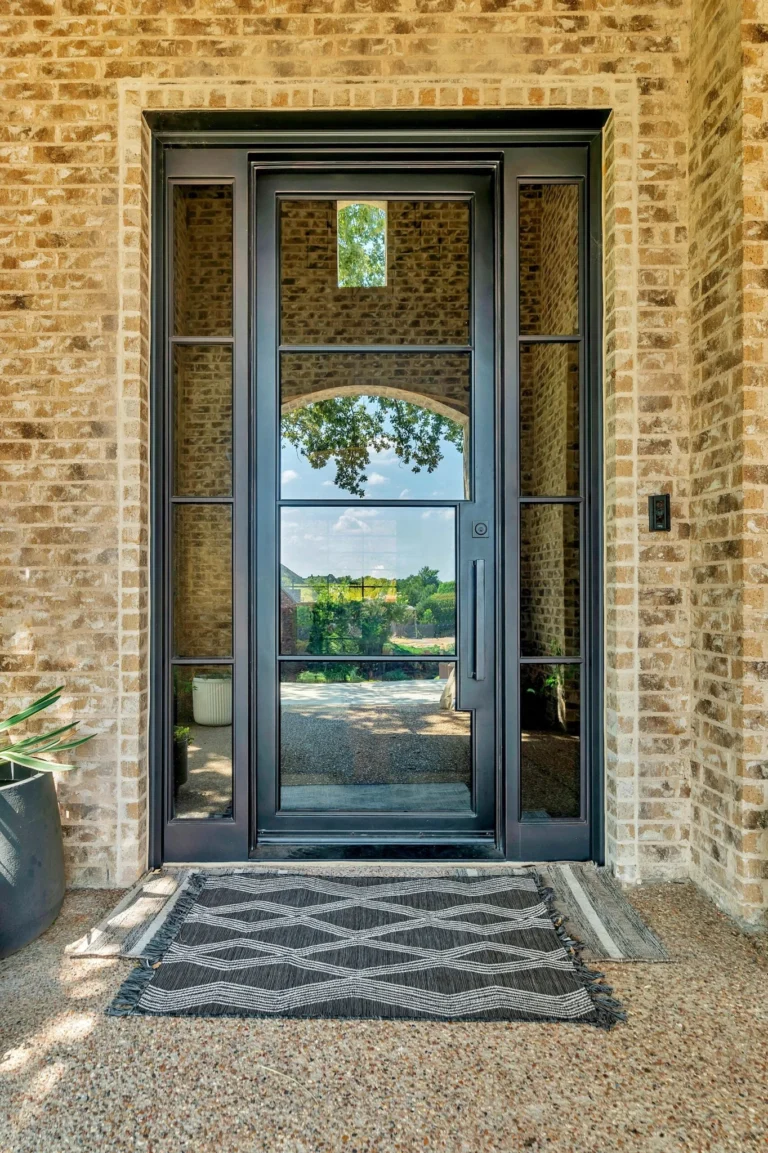
Hardware duty cycles are the biggest engineering difference. A lever that feels fine on a front door will wear out in a busy commercial opening.
- Continuous hinges — distribute constant load across the full door height.
- Heavy-duty closers — control the door through thousands of open-close cycles.
- Access-controlled exit hardware — panic bars and latch systems sized to code.
- Residential sets — premium levers and locksets built for daily but lighter use.
We match the hardware to the duty. That is why our one-piece transom engineering matters on big commercial glass spans — the frame has to stay square under the load.
Schedule your free consultation.
How Do Frame and Panel Engineering Differ Between the Two?
The biggest framing difference is how we handle wide openings and tall glass. Commercial doors often need structural transoms and reinforced jambs; residential doubles need clean, stable alignment.
- Structural transoms — one-piece engineered lintels carry the load above wide glass.
- Reinforced jambs — heavier hinge reinforcement for constant-cycle doors.
- Stable doubles — residential double doors use a unified frame so leaves stay aligned.
- Gasket duty — commercial builds use heavy-duty compression seals that take constant abuse.
This is the crux of what I cover in the engineering behind custom steel doors — the structure under the visible face is where a door earns its price. Whatever the build, it all starts in our DFW entry door process with a consult that matches the door to the building.
FAQ
Q: Are commercial and residential steel doors made of different steel?
A: No. Both use the same 10-gauge cold-rolled steel with a zinc coating and triple-coat paint. The differences come from hardware, frame engineering, and build size.
Q: Why are commercial steel entry doors more expensive?
A: Commercial builds use heavier hardware, bigger glass, structural frames, and more code and site work, which all add cost. A high-end residential door with wide glass can reach the same price.
Q: What hardware does a commercial steel door need?
A: Commercial doors need continuous hinges, heavy-duty closers, and access-controlled exit hardware to survive thousands of open-close cycles.
Q: Do residential steel doors wear out faster?
A: Not usually. Residential doors see fewer cycles but fight more weather exposure. Either type needs routine hinge, gasket, and finish care.
Q: Can one company build both commercial and residential steel doors?
A: Yes. A vertically integrated manufacturer that owns its factories can build and support both, with the same control over specs and warranty.
Q: What warranty covers a custom steel entry door?
A: Our steel entry doors carry a lifetime frame and slab warranty, 10-year finishes, 5-year glass, and 1-year labor.